Doors
A door comes from the catalogue: open its Doors category and drop a door on a wall. In the checklist, the Add doors and windows row has a button, Open the door catalogue, that takes you there. The door is then made right here. The panel opens when the door is selected, and every section of it answers one question: what kind, how big, how it opens, what it is glazed with, what it is made of.
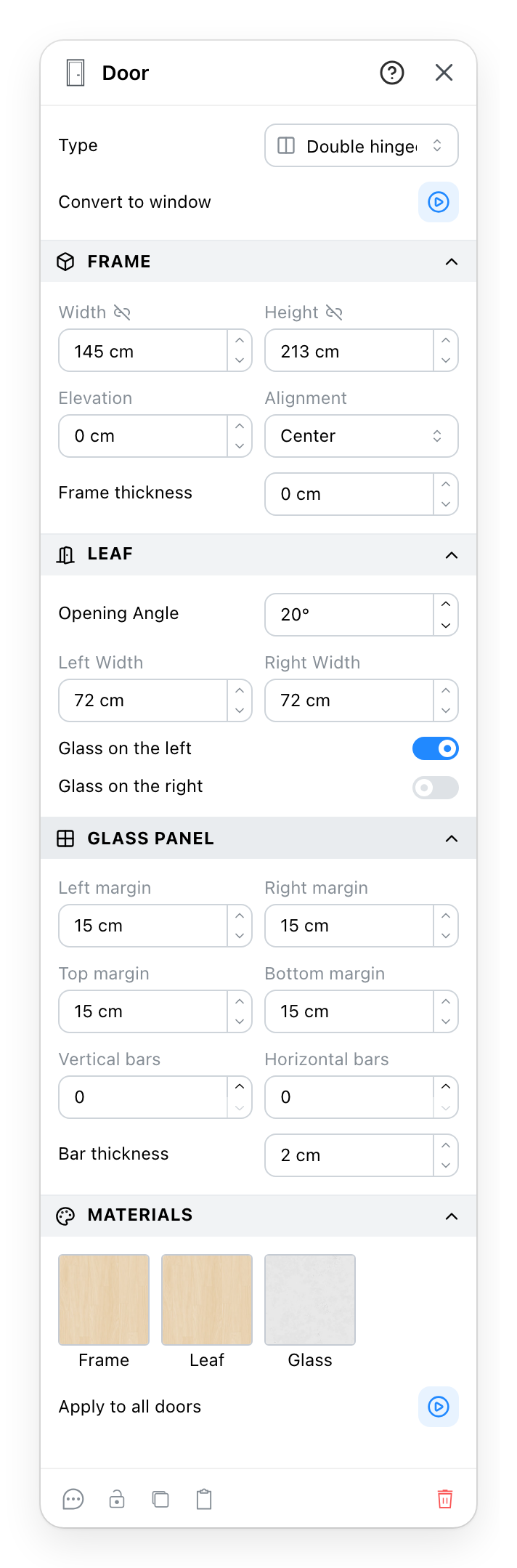
- What kind of door this is: hinged, double hinged, pocket or sliding; Garage opens a second list with sectional, roller and tilt-up. Convert to window asks first, then keeps the opening and its frame and gives it a window's settings; the door's own settings are lost.
- The opening in the wall: width and height, the elevation of the sill above the floor, and for hinged and garage doors which face of the wall the frame sits flush with. Frame thickness is the visible width of the frame around the leaf; pocket and sliding doors have none. The lock holds the size, the elevation and the alignment.
- The leaf itself: how far it stands open, which side it opens from on a hinged, pocket or sliding door, and for a double door the width of each half. A leaf narrower than 50 cm gets no handle. A switch puts glass in the leaf; a double door has one per leaf.
- The glass, as margins from the edges of the leaf, so every leaf works out its own pane. Bars divide it; the counts belong to the largest pane and the others follow with panes of about the same size.
- One material per part: the frame, the leaf, and the glass when there is one. Apply to all doors pushes these three onto every door on this level.
- Every property panel ends with a comment, a lock, a duplicate, a copy and a delete, and the ? in its header opens this page.
1 Which sections you get
The panel only shows what the type can use. A sliding door has no opening angle but an opening rate, a percentage of how far it is drawn. A garage door has a rate too, and a sectional one gets its glass per panel. The roller door is the one kind with no glass at all.
2 Elevation can be negative
A door normally stands on the floor, so its elevation is zero. A negative value sinks the opening into the level below, which is how an opening is cut through a floor.
4 Glass by margins, not by size
The glass is not given a size. It is given four distances from the edges of the leaf, and each leaf keeps its pane inside them. That is why a double door with two leaves of different widths shows two panes of different widths from the same settings, and why a narrow leaf can end up with no bars where the wide one has two.
See also
- Drawing Tools is where a wall is drawn before a door goes into it.
- Materials is the catalogue the three material tiles open on.
- Comments for a note kept on this door.